



Google March 2026 Spam Update – What Every Website Owner Must Know Right Now
Google just rolled out its first spam update of 2026. It is live globally. Your rankings may already be shifting.
Google just pushed a major update. It went live yesterday — March 24, 2026. Moreover, it is already affecting rankings worldwide. If your website traffic looks unusual today, this update could be the reason.
In fact, this is Google’s first spam update of 2026. Therefore, every business owner and website manager needs to understand what it means. This post covers everything — what happened, why it matters, who is at risk, and what to do right now.
What Is the Google March 2026 Spam Update?
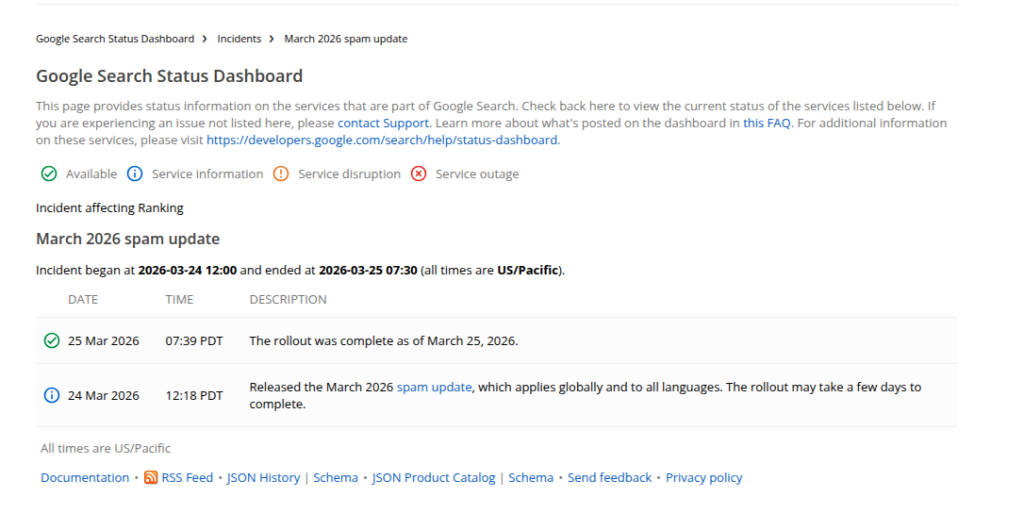
Google confirmed the update on its Search Status Dashboard on March 24, 2026 at 12:18 PM PDT. It is classified as an “Incident affecting Ranking.” In other words, Google itself acknowledges this is causing ranking changes right now.
Google’s official statement on LinkedIn said:
📢“Today we released the March 2026 spam update to Google Search. This is a normal spam update, and it will roll out for all languages and locations. The rollout may take a few days to complete.” — Google Search Central
So what does “normal spam update” mean? It means Google has improved its automated spam detection systems. As a result, sites that were previously slipping through are now being caught. Moreover, it is not a core update — it targets a specific set of policy violations.
Why Did Google Release This Update Now?
The last spam update was in August 2025. That update took nearly 27 days to complete. So Google’s spam detection systems have been quiet for about 7 months. Therefore, this March update is overdue — and likely more impactful because of that gap.
In addition, the SEO industry has been seeing unusual SERP volatility throughout early 2026. Tools like SEMrush Sensor and SISTRIX have recorded elevated movement over the past month. As a result, many SEOs were already expecting an enforcement action soon.
Moreover, there is a broader context here. SEO expert Lily Ray from AMS Digital predicted in December 2025 that Google would crack down on AI-generated spam content in 2026. However, Google has not confirmed this is specifically targeting AI content. That question will only be answered once data emerges over the next few weeks.
What Types of Spam Does This Update Target?
Google has not released a specific breakdown of this update’s focus. That is completely normal — Google rarely does. However, based on Google’s spam policies documentation, the update works through SpamBrain — its AI-powered spam detection system. SpamBrain covers all known categories of spam simultaneously.
Specifically, here are the types of spam this update may enforce:
| Spam Type | What It Means | Risk Level |
|---|---|---|
| Link Spam | Paid links, private blog networks (PBNs), unnatural link schemes | High Risk |
| Content Spam | AI-spun articles, scraped content, thin pages with no real value | High Risk |
| Cloaking | Showing different content to Google vs real users | High Risk |
| Doorway Pages | Pages made only to rank for keywords — no genuine user value | Medium Risk |
| Sneaky Redirects | Redirecting users to pages different from what Google crawled | Medium Risk |
| Keyword Stuffing | Filling pages with keywords unnaturally to manipulate rankings | Medium Risk |
⚠️
This update does NOT introduce new spam policy categories. Therefore, the existing Google spam policies are what you need to review. If you follow those guidelines, you are likely safe.
How Does This Update Differ from Past Spam Updates?
Understanding the timeline helps. Here is how this update compares to recent ones:
March 2026 Spam Update (Completed)
Started March 24, and complete as of March 25, 2026 First spam update of 2026. Global, all languages. No new policy categories announced.
August 2025 Spam Update
Ran August 26 – September 22. Took 27 days. Characterised as penalty-only. Affected spammy domains lost visibility. However, no broad ranking changes were observed beyond that.
December 2024 Spam Update
Completed in 7 days — a relatively fast and focused rollout.
March 2024 Spam Update
Introduced new policy categories — content abuse, expired domain abuse, and site reputation abuse. A much broader policy change than what we are seeing now.
Therefore, the March 2026 update appears more targeted than the August 2025 update. A shorter rollout typically means a more focused enforcement — not a sweeping broad change.
Which Websites Are Most at Risk Right Now?
Google confirmed that all languages and locations are affected equally. Moreover, within the first 48 hours, rank-tracking tools recorded elevated volatility in specific verticals. According to sources monitoring SERP changes, these categories showed the most movement:
- Affiliate content sites with thin reviews and heavy commercial linking
- Local business aggregator pages with doorway pages for individual cities
- Guest posting networks using unnatural anchor text patterns
- Programmatic content sites publishing high volumes of templated pages
- Finance, health, and affiliate review sites — historically high spam activity
- Sites with purchased backlinks or private blog network (PBN) links
🚨
Important: A spam update is NOT a manual penalty. Google does not notify you. Instead, ranking changes are the only signal. Therefore, you need to monitor your Search Console data closely right now.
How Do You Know If Your Site Is Affected?
First, do not panic if you see a traffic dip today. Ranking fluctuations happen for many reasons. However, there is a specific way to check whether this update is responsible.
Here is how to confirm whether this update hit your site:
- Open Google Search Console and go to the Performance report
- Set the date range to start from March 24, 2026
- Look for a drop in clicks and impressions starting on or after that date
- Check if the drop is across your whole site — or only specific pages
- Use SEMrush or Ahrefs to monitor keyword ranking changes from March 24 onward
- Compare your traffic source breakdown — organic drops specifically suggest a ranking change
Moreover, if your drop started well before March 24, this update is probably not the cause. In that case, look at technical issues first — not this update.
How Do You Recover If Your Site Is Hit?
Recovery from a spam update is possible. However, it is not quick. Google states that improvements may take months to reflect — because the system needs to observe sustained compliance over time, not a one-time fix.
In addition, there is one important exception: link spam. If Google neutralised the value of backlinks, that ranking benefit cannot come back — even after you remove the bad links. Therefore, prevention is always better than recovery.
Here are the specific steps to take right now:
Audit Your Backlink Profile Immediately
Use Ahrefs or SEMrush to identify unnatural links. Then use Google’s Disavow Tool to flag harmful ones. However, only disavow links you are confident are harmful — removing good links can hurt your rankings further.
Remove or Improve Thin Content Pages
Identify pages with very low word count, no original insight, or content clearly written just to rank. Either delete them, redirect them to stronger pages, or rewrite them with real value and original information.
Check for Cloaking and Redirect Issues
Make sure the content Google sees is exactly the same as what your users see. Therefore, use Google’s URL Inspection Tool to compare the rendered page against what your users actually get.
Review AI-Generated Content Carefully
AI content itself is not banned. However, AI content that has no original insight, real experience, or added value is a spam risk. As a result, review all AI-generated pages and ensure each one genuinely helps the reader.
Monitor Search Console Daily for the Next 7 Days
The rollout is still in progress as of today, March 25. Therefore, the full impact may not be visible yet. Check your performance data daily and compare against the March 24 baseline to track changes in real time.
What Should You Do If Your Site Is NOT Affected?
Good news first: if you follow Google’s Search Essentials guidelines, this update is unlikely to harm you. Moreover, some clean sites may actually see a rankings improvement — because spammy competitors are being demoted.
In addition, here is what you should do regardless of whether you are affected:
- Keep producing helpful, original, user-first content — not content written purely to rank
- Build backlinks naturally through quality content, not paid schemes or PBNs
- Ensure every page on your site has a clear purpose and genuine user value
- Use schema markup to help Google understand your content correctly
- Regularly audit your backlink profile — at least every 3–6 months
- Stay updated with Google Search Central — follow their official X account for announcements
✅
Bottom line: Spam updates reward sites that play by the rules. Therefore, the best long-term strategy is simply to build a genuinely useful website. That is exactly what we do for every client at SEO With Venky.